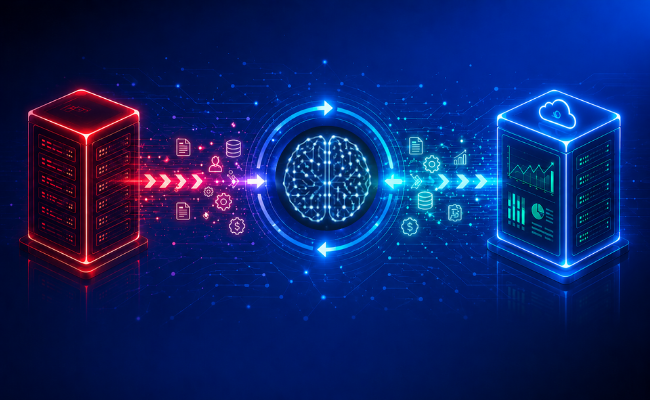
Migrating a core banking system is the closest thing in technology to performing heart surgery on a patient while they are going about their everyday activities. The system cannot stop. The customers cannot wait. And the stakes of getting it wrong are existential. AI now has the potential to make it possible for migrations to proceed without impacting the customers, whilst also delivering positive long-term outcomes.
A core banking migration is unlike almost any other technology programme. The system being replaced is not peripheral, it is the beating heart of the institution, processing every transaction, holding every customer account, underpinning every product that generates revenue. It cannot be taken offline. It cannot be paused. Customers do not stop needing their accounts while the plumbing beneath them is being rebuilt from scratch.
That is what makes legacy migration so uniquely difficult, and why so many programmes have been deferred, descoped, or abandoned entirely. The risk of getting it wrong is not an inconvenience; it is an operational, regulatory, and reputational event. And yet the cost of not doing it is compounding. Every year spent on legacy infrastructure is a year of innovation forgone, a year of data locked in formats that AI cannot consume, a year ceding ground to institutions that made the transition earlier.
AI is changing the risk calculation. Applied thoughtfully across the typical stages where migrations most commonly stall, it can compress timelines, cut data error rates significantly, and shift compliance from a retrospective exercise to a continuous one. The question is no longer whether to operate, it is whether the surgical team and the operating theatre are equipped for what comes next.

Challenge 1 – The Codebase Nobody Fully Understands
Most legacy banking systems were built in COBOL, VSAM, or Assembly at a time when those were the right tools for the job. The developers who wrote them have long since retired. The original design documents are sparse or missing entirely. And decades of patching, extending, and customising have produced a codebase where the original logic is buried beneath layers that are effectively undocumented — understood only through tribal knowledge that walks out the door with every wave of retirements.
AI tools can now analyse these codebases systematically, mapping dependencies, identifying conflicts, and translating legacy code into modern languages at a pace no human team could sustain – exposing the complexities and potential issues ahead of a migration. The dependency mapping alone is transformative. Before AI, understanding the knock-on effect of changing a single legacy module required weeks of analysis and remained incomplete. AI surfaces those interdependencies comprehensively before any production code is touched, turning a process that was partly guesswork into something that can be planned with genuine precision.
“The problem with legacy code isn’t just that it’s old, it’s that the institutional memory that made it comprehensible has gone with the people who wrote it. AI gives you a way to reconstruct that understanding quickly and systematically at scale “, Paul Payne, CTO, SaaScada
The Benefits of Migrating to SaaScada
An Architecture That Eliminates the Tangle Rather Than Recreating It
SaaScada was built from first principles using Command Query Responsibility Segregation (CQRS) and event streaming, by founders who had worked inside the monolithic legacy systems this architecture is designed to replace. There are no product modules with hidden interdependencies. Features are added as discrete, composable blocks that take just hours or even minutes to configure and can be changed without cascading regression effects on the rest of the platform.
The cohabitation model means institutions can run SaaScada alongside their existing core, migrating product lines progressively at their own pace, removing the need to understand the entire legacy codebase before a single customer can move. See how we did it with Allica Bank.
Challenge 2 – Data that Cannot Be Trusted at Speed
Code migration is the visible part of a programme. Data migration is where change programmes most commonly fail. Legacy systems store data in formats and structures defined around product assumptions of thirty years ago. Moving it requires transformation, and every transformation is an opportunity for error. The consequences are serious: incorrect balances, lost transaction histories, reporting failures, and damage to customer trust that takes years to repair.
AI-driven predictive validation can identify integrity issues before they propagate, cutting error rates inherent to manual approaches. Automated data mapping matches fields between legacy and new systems without the weeks of analyst time required by manual mapping. Continuous data cleansing enriches and classifies data as it moves, ensuring what arrives on the new platform is not just transferred, but meaningfully improved in quality and consistency.
“Banks need to be increasingly data-driven, but most legacy cores were never built to make data genuinely accessible. The data exists, it just can’t be reached at the speed or granularity that AI actually requires. For a migration to be truly successful, you have to break free of these dated lock-in restrictions and regain control of your data.” – Paul Payne, CTO, SaaScada
The Benefits of Migrating to SaaScada
An Immutable Ledger That Makes Data Trustworthy by Design
SaaScada enforces a strict segregation of transaction, item, and master data. Its immutable event ledger means every point in time can be reproduced in real time from the customer’s perspective, not as a validation exercise run after the fact, but as a structural property of how the platform stores information. Data is never overwritten: every state change is recorded, auditable, and reproducible. Where legacy systems degrade data quality through repeated patching, SaaScada’s event-sourcing model makes data integrity a baseline. This is also the foundation that allows AI systems to function reliably downstream. Clean, real-time, structured data is the prerequisite for useful AI, and SaaScada provides it architecturally.
Challenge 3 – Testing That Never Feels Complete
Testing is the phase that absorbs the most time and generates the most programme anxiety. The combinations of product configurations, customer scenarios, and edge cases in a core banking migration are effectively infinite. Manual creation of test scripts is slow. Coverage is inevitably incomplete. And human testers inevitably miss the edge cases that cause production incidents on go-live day, the ones that only surface under specific combinations of conditions that nobody thought to simulate.
AI changes this in two distinct ways. It generates test cases automatically from product acceptance criteria, eliminating the bottleneck of manual test writing and dramatically expanding the coverage that was previously possible. When overseen by an experienced human tester to confirm the required outcomes, it can drastically cut testing time. Regression testing that once took weeks can run overnight.
The Benefits of Migrating to SaaScada
A Product Engine Where Regression Risk Is Structurally Contained
Because SaaScada products are built from discrete, composable feature blocks rather than woven into a monolithic codebase, changes to one block cannot cascade unpredictably through the rest of the platform. The impact of any configuration change is defined and bounded by design. Environments are available in two weeks, enabling parallel running from the earliest stages of any migration programme, which means institutions can test customer journeys and product configurations against a live SaaScada environment long before any production data is moved.
Challenge 4 – Regulatory Exposure That Compounds With Every Delay
Banking migrations do not happen outside regulatory scrutiny. Every system change must be documented and defensible. Every transformation of customer data must be auditable and explainable. And the longer a programme runs, the greater the risk that the regulatory landscape shifts, requiring rework of components already considered complete, and extending a programme that has already stretched resources close to breaking point.
AI embedded in the migration pipeline can catch compliance issues at the moment of code commit, not in a final review phase when remediation costs an order of magnitude more. Automated documentation generates the audit trail regulators require in real time rather than requiring it to be reconstructed after the fact. Real-time compliance risk monitoring during the migration itself provides visibility into operational integrity issues as they develop, enabling teams to intervene before a problem becomes a breach.
“Compliance can’t be an afterthought in a migration, by the time you find a problem in the final review, you’re already in trouble. The institutions that get this right treat regulatory transparency as a property of the architecture, not a box to tick at the end of the programme.” – Steve Round, President & Co-Founder, SaaScada
The Benefits of Migrating to SaaScada
Audit-Ready Infrastructure, Not an Afterthought
SaaScada’s immutable event log creates a complete, timestamped record of every transaction and system state as a core property of the platform, not a compliance layer added after the fact. Every product change is traceable. Every customer account state is reproducible at any point in time. The same architecture that gives SaaScada its real-time data capability is the architecture that makes compliance transparent: data flows are visible, data lineage is preserved, and nothing is overwritten. For institutions operating under close regulatory supervision during a live migration, this is the difference between a programme that can demonstrate its integrity at any moment and one that can only hope the auditors don’t look too closely.
Challenge 5 – Products That Still Take Months to Configure
Perhaps the most commercially demoralising migration outcome is to emerge on the other side of a multi-year programme and find that product development is barely faster than before. The backlog of product changes that accumulated during years of migration now needs to be cleared. Teams are burnt out. And the new core, despite the investment, still requires lengthy development cycles before anything meaningful can be configured and launched.
The emerging answer is the application of AI to product configuration, enabling product managers to use AI to rapidly build products, providing they are using a core banking system that has modern APIs, accessible event-based architecture and product configuration tools that put control in the hands of the product manager. Instead of raising change requests with engineering teams and waiting weeks for delivery, they iterate at pace. AI also enables rapid prototyping of product variants before launch, compressing the time from concept to customer to a fraction of what legacy systems imposed.
“The moment a bank finishes a migration and finds itself back in a months-long queue to change a product feature, something has gone wrong. The whole point of moving to a modern core is to get off that treadmill permanently, not just to reset the clock.” – Steve Round, President & Co-Founder, SaaScada
The Benefits of Migrating to SaaScada
The Product Sequencer — Banking Products at the Speed of Thought
SaaScada’s Product Sequencer is built for product teams who should not need to depend on engineering cycles to change a savings rate or add a fee structure. The full range of banking products, accounts, payments, savings, loans, multi-currency wallets, can be assembled from pre-built feature blocks without writing code. New blocks are added to the platform in two to three days. Products can be trialled with specific customer segments, measured against real-time usage data, and refined without waiting for the next development sprint. SaaScada’s own research shows that product owners report 176 days on average to launch a new product on legacy cores. On SaaScada, the same outcome is achievable in weeks.
The Prognosis is Great, If You Choose the Right Team
The legacy IT challenge facing banks is real, it is urgent, and it is solvable. AI has materially changed the economics of migration, cutting timelines, reducing error rates, and making compliance continuous rather than retrospective. The tools exist. The case is proven. The operation no longer has to be as dangerous as it once was.
But surviving the procedure is not the same as being healthy afterwards. A migration that transplants the same failing architecture into a new environment, that replicates legacy logic under a cloud-washed exterior, leaves the patient dependent on the same medication as before. The banks and fintechs that will lead the next decade are those that emerge from migration onto infrastructure designed from first principles for the AI era: real-time data as a structural property, products that don’t require engineering teams to reconfigure, partner eco-systems that can grow and flex, and audit trails that are built-in rather than bolted on.
The migration is not the goal. It is the operation that makes the goal possible. And it starts by choosing a platform built for a long and healthy life after the procedure.
Used as a primary core or alongside legacy systems, SaaScada supports a phased migration strategy that manages risk without sacrificing momentum. Clients include Allica Bank, one of the UK’s fastest-growing SME Banks, and Solance, powering a new multi-currency payments platform.
Migration doesn’t have to be as daunting as you think.